
Should Your Parish Accept Online Mass Intentions?
More pastors and parish administrators are asking whether they should accept Mass intention requests online. This guide walks through the pastoral, practical, and canonical considerations, and offers best practices for deciding and implementing an online system well.
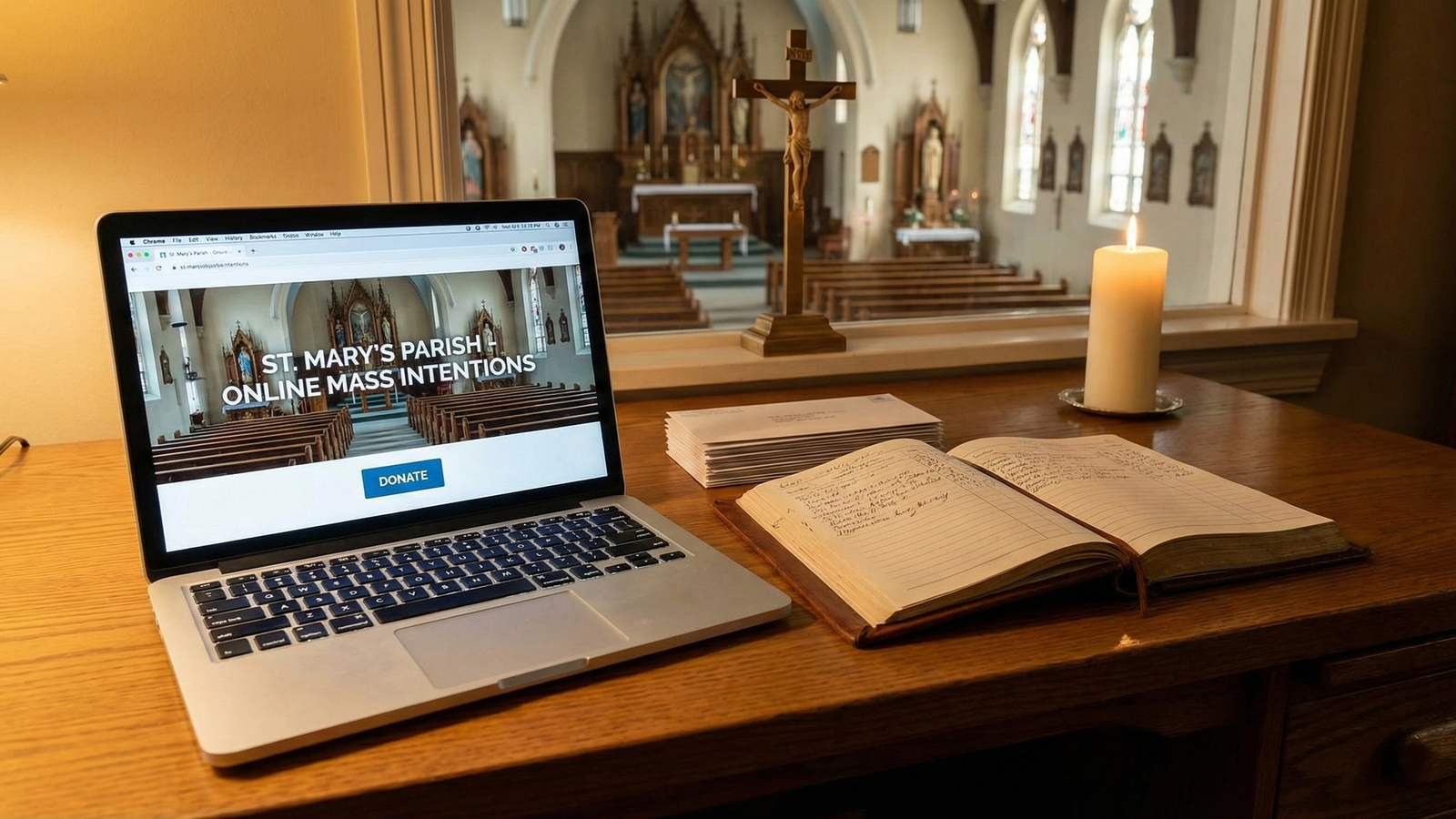
Should Your Parish Accept Online Mass Intentions?
It's 9 PM on a Tuesday. A parishioner's mother just passed away, and they want to request a Mass intention. Your parish office closed at 4 PM. The funeral home is asking about arrangements tomorrow morning. The family will have to wait until the office reopens—or hope someone answers the phone during the brief window between morning Mass and the lunch hour.
This scenario plays out in parishes every week. And it raises a question more pastors and parish administrators are asking: should we accept Mass intention requests online?
The answer isn't simply "yes" or "no." It depends on your parish's capacity, your parishioners' needs, and how well you implement the system. This guide will help you think through the decision.
The Case for Online Mass Intentions
Accessibility Beyond Office Hours
Parish offices typically operate limited hours—often just mornings on weekdays. But life doesn't follow office schedules. Deaths happen at night. Families gather on weekends. People travel for work and can't visit during business hours.
Online intention requests allow parishioners to submit requests whenever they need to, from wherever they are. A son living across the country can request a Mass for his father's anniversary. A busy professional can submit a request at 10 PM after the kids are in bed. A grieving widow can request a Mass for her husband immediately after receiving the news, finding comfort in that small act even before she can speak to anyone at the parish.
Reaching Younger Parishioners
Parishioners under 50 increasingly expect digital options for routine transactions. They bank online, schedule medical appointments through apps, and order groceries from their phones. When the parish requires an in-person visit or phone call for something as simple as a Mass intention, it can feel like an unnecessary barrier.
This isn't about catering to preferences—it's about removing obstacles to participation. If a young family finds it easier to request a Mass intention online than to coordinate a trip to the parish office with two toddlers in tow, they're more likely to request one at all.
Administrative Efficiency
Online systems capture requests in a structured format. No more deciphering handwriting on intention cards. No more phone calls interrupted by other office tasks. No more manually entering the same information into multiple systems.
When a parishioner submits an online request, the system can automatically capture their name, contact information, the intention details, the preferred date (if any), and payment information. Staff time shifts from data entry to pastoral follow-up—calling a grieving family to express condolences rather than transcribing their phone message.
Integrated Payment Processing
Accepting stipends online solves several practical problems. Parishioners don't need to bring cash or write checks. The parish doesn't need to handle as much physical money. Reconciliation becomes straightforward because every stipend is automatically recorded with its corresponding intention.
Some systems even allow parishioners to cover transaction fees, so the full stipend amount reaches the parish. Others let donors add an additional offering above the standard stipend.
Better Record-Keeping
Canon 958 requires parishes to maintain careful records of Mass intentions—the intention, the stipend, and whether the Mass was fulfilled. Paper systems work, but they're vulnerable to human error, lost cards, and filing mishaps.
Digital systems create automatic audit trails. Every intention is logged from request through fulfillment. Reports can be generated for diocesan reviews. Nothing falls through the cracks because a sticky note got lost.
The Case for Caution
The Personal Touch Matters
When someone requests a Mass intention, they're often experiencing something significant—grief, worry, gratitude, hope. The interaction with parish staff can be pastoral, not just transactional. A secretary who takes the time to express sympathy, offer to light a candle, or mention that Father will keep the family in his prayers provides something an online form cannot.
If online requests completely replace personal interactions, something valuable is lost. The question isn't whether to offer online options, but how to maintain pastoral connection alongside them.