
Mass Stipends Explained: How Much to Give & What Canon Law Says (2026)
How much is a Mass stipend in 2026? Most U.S. dioceses suggest $10–$25. Learn what a Mass stipend means, current amounts by diocese, Canon Law rules, and proper etiquette for offering a Mass intention.
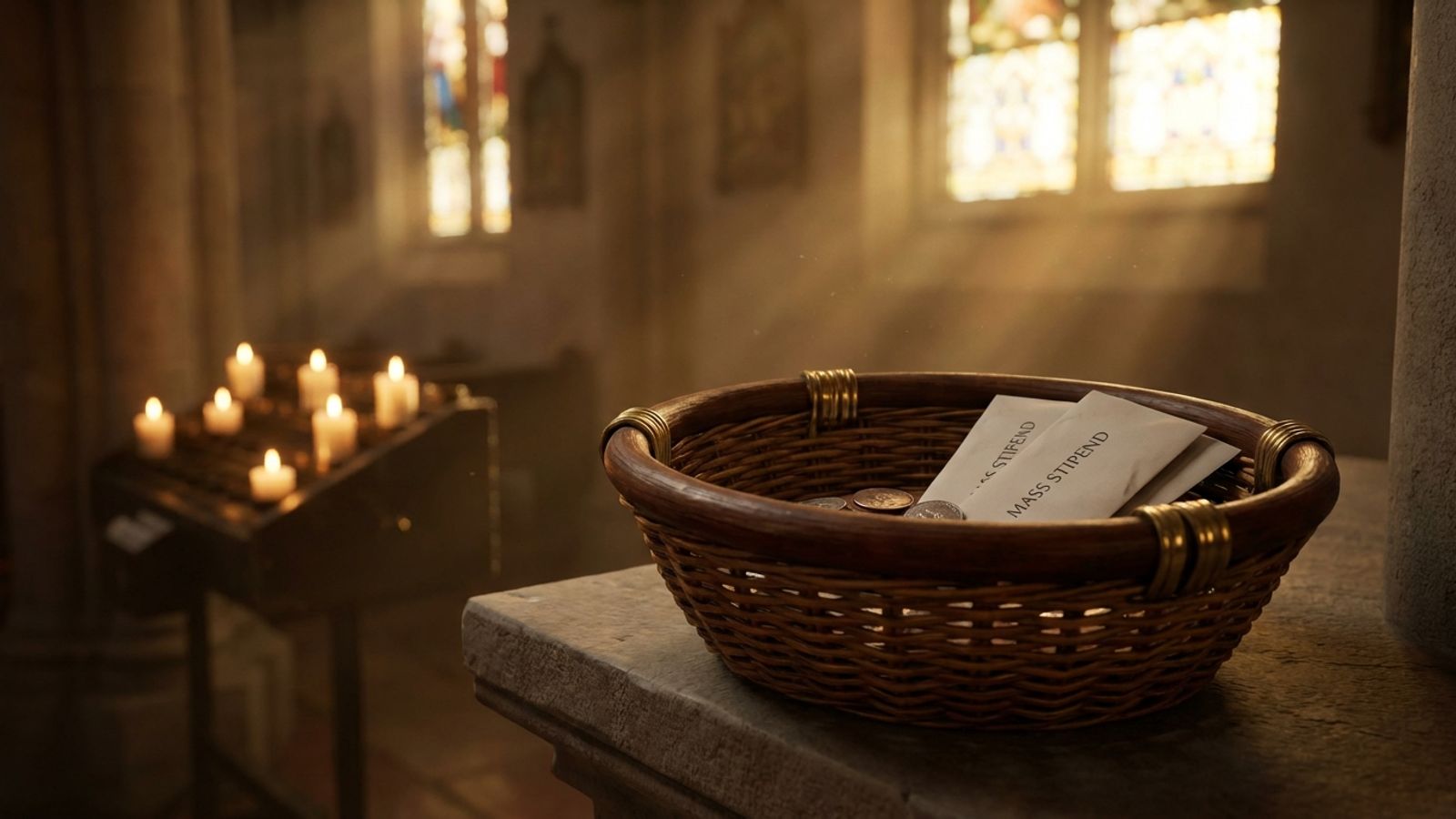
You want to request a Mass intention for a loved one, but you're unsure about the offering. How much should you give? Is there a set amount? What if you can't afford it? These questions are more common than you might think, and the answers reveal a beautiful aspect of Catholic tradition that balances spiritual devotion with practical support for the Church.
This guide explains everything you need to know about Mass stipends in 2026: what they are, how much to give, the Canon Law behind them, and the etiquette that ensures your offering honors both the sacred nature of the Mass and the practical needs of your parish.
What Is a Mass Stipend?
A Mass stipend is a monetary offering given to a priest when requesting that a Mass be celebrated for a specific intention. Canon Law defines it as "a certain monetary offering which anyone makes to the priest with the accompanying obligation of celebrating a Mass in accordance with the intentions of the donor."
The practice dates back to around the eighth century, when it emerged as a practical substitute for the earlier custom of bringing food, wine, and other necessities directly to the clergy. Today, the stipend serves two purposes: it allows the faithful to participate more deeply in the Mass through their sacrifice, and it provides material support for priests and the Church's mission.
It's important to understand that you are not "buying" a Mass. The Mass has infinite value and cannot be purchased. Rather, your offering represents your personal sacrifice and participation in the Church's work, while the priest accepts an obligation to apply the fruits of that particular Mass to your intention.
How Much Is a Mass Stipend in 2026?
In the United States, Mass stipend amounts typically range from $10 to $25, with $10-15 being the most common suggested amount. However, these amounts vary by diocese, as Canon 952 gives provincial councils and individual bishops the authority to establish recommended offerings for their region.
The suggested amount is exactly that — a suggestion, not a requirement. You may offer more or less based on your means, and your parish office can tell you the local recommended amount if you're uncertain. What matters is that priests cannot demand more than the diocesan standard, and they are encouraged to celebrate Mass for those who cannot afford any offering at all.
If you wish to offer more than the standard amount for a single Mass, simply make that clear when you submit your request. For example, if you give $50 and specify "for one Mass," the priest will celebrate one Mass for your intention. If you give $50 without specification, and the diocesan rate is $10, the parish may schedule five Masses.
Canon Law and Mass Stipends
The Church takes Mass stipends seriously. Canons 945-958 of the Code of Canon Law establish detailed requirements to protect both the faithful and the integrity of the practice.
Obligations for Priests
- One stipend, one Mass: A priest may only retain one stipend per Mass celebrated, even if he celebrates multiple Masses in a day (Canon 951)
- Timely fulfillment: Accepted intentions must be celebrated within one year (Canon 953)
- Record keeping: Parishes must maintain registers of accepted and fulfilled Mass intentions, subject to annual review by the bishop (Canon 958)
- No excess retention: When stipends exceed what a priest can fulfill, the excess must be forwarded according to diocesan policy
Protections for the Faithful
- No one should be denied a Mass intention due to inability to pay (Canon 945 §2)
- Stipend amounts are regulated to prevent any appearance of commercialization
- Your intention will be fulfilled — the Church takes this obligation seriously
Mass Stipend Etiquette
While there are no rigid rules about requesting Mass intentions, certain practices will ensure a smooth process and show respect for the sacred nature of the Mass.
When submitting your request, be clear about your intention — provide the name or names of the person(s) you wish to have remembered, and specify whether the intention is for someone living or deceased. This clarity helps the parish record the intention accurately and ensures the priest knows exactly who he is praying for during the Holy Sacrifice.
Planning ahead is essential, especially for meaningful dates like death anniversaries or birthdays. Many parishes are booked weeks or even months in advance, so if you have a specific date in mind, reach out to your parish office as early as possible. The more popular times — All Souls Day, Christmas, Easter — fill up particularly quickly.
The offering itself should represent a meaningful sacrifice for you, whatever that amount might be. Don't feel embarrassed if you cannot afford the suggested amount — priests are required to celebrate Mass for those who cannot pay, and any good pastor will honor your intention regardless of the offering. What matters is not the size of your gift but the sincerity of your participation in the Church's mission.
For those who have lost a loved one, consider requesting Gregorian Masses — a powerful traditional practice of 30 consecutive Masses offered for the repose of the soul. Not all parishes offer this option, but it represents one of the most ancient and revered traditions in the Church's prayer for the dead.
Where Does the Money Go?
This is a question many Catholics have but hesitate to ask. The answer is straightforward: Mass stipends traditionally go directly to the celebrating priest as part of his support.
In practice, how stipends are handled varies depending on the priest's situation. Diocesan priests typically receive a salary, and stipends may supplement their income or go to parish operations. Religious order priests who live under vows of poverty give their stipends to their community. When stipends exceed what a priest can personally fulfill — a common situation in busy parishes — the excess is forwarded to missions, seminaries, or priest retirement funds.
Your offering, however it is ultimately distributed, supports the Church's mission and the priests who serve you.
Can Multiple Intentions Be Combined?
This is a nuanced area of Canon Law that's worth understanding.
One offering, multiple names: If you make a single offering and request that Mass be said for "John, Mary, and Grandma," that counts as one intention. You can include multiple people in a single Mass intention.
Multiple offerings, one Mass ("collective intentions"): Under special circumstances and with proper permission, multiple separate intentions may be combined into a single Mass. However, this requires that all donors be informed beforehand and freely consent. Parishes may do this no more than twice per week.
When you request a Mass intention, it will typically be applied to a single Mass unless your parish has a collective intention policy and you've been informed of it.
What If I Can't Afford a Stipend?
This is perhaps the most important point in this entire guide: no one should be denied a Mass intention because they cannot pay.
Canon 945 §2 states that priests are "earnestly recommended" to celebrate Mass for the intentions of the faithful, especially the poor, even without receiving any offering. If you are experiencing financial hardship, speak privately with your pastor or the parish office. Any good priest will be honored to offer Mass for your intention regardless of payment.
Remember: the spiritual practice of having Mass offered for an intention should never be limited to those who can afford it. This is fundamental to the Church's mission.
Mass Stipends vs. Stole Fees
You may have heard of "stole fees" and wondered how they differ from Mass stipends. The distinction is straightforward: Mass stipends are specifically for Mass intentions and create an obligation for the priest to celebrate Mass for your intention. Stole fees, on the other hand, are offerings associated with other sacraments like Baptism, Marriage, or Funerals, and they do not create a Mass obligation.
Both are governed by Canon Law, and both have suggested amounts set by the diocese. As with Mass stipends, no sacrament should ever be denied due to inability to pay.
How Sacramentum Helps Parishes Manage Stipends
For parish staff, tracking Mass stipends manually can be overwhelming. Paper systems make it difficult to ensure every intention is fulfilled, every offering is properly recorded, and every Canon Law requirement is met.
Sacramentum provides complete Mass intention and stipend management with built-in Canon Law compliance. Our system automatically tracks unfulfilled intentions, manages priest payouts, and generates the detailed registers required by Canon 958 — all while giving parishioners the option to request intentions online with integrated payment processing.
Whether your parish handles a few intentions per week or hundreds, proper stipend management ensures that every offering is honored and every intention is fulfilled.
Conclusion
Mass stipends are a beautiful expression of our participation in the Church's mission. Your offering — whatever the amount — represents a sacrifice that unites you more deeply to the Mass being celebrated for your intention. At the same time, it supports the priests and parishes who serve the faithful.
Don't let uncertainty about amounts or etiquette prevent you from requesting Mass intentions. Contact your parish office, ask about their suggested offering, and know that your intention — for the living or the dead, for healing or thanksgiving, for any need at all — will be brought before the Lord in the Holy Sacrifice of the Mass.